
Industrial Vacuum Pump Systems
Select the right vacuum pump for reliable, energy-efficient industrial performance.
Industrial vacuum pumps are used across manufacturing, food processing, packaging, laboratories, medical facilities and heavy industry to create reliable negative pressure for production processes. Choosing the correct vacuum technology improves productivity, reduces operating costs and helps maintain consistent system performance.
Air Energy supplies a wide range of industrial vacuum pumps and vacuum pipework components from trusted global manufacturers. Whether you're replacing ageing equipment, expanding production or designing a new vacuum system, our technical team can help you select equipment suited to your application.
Quick Answer
Industrial vacuum pumps create negative pressure by removing air or gas from a sealed system. Air Energy supplies rotary screw, rotary vane, claw, scroll, centrifugal and blower vacuum pump technologies for applications including manufacturing, packaging, laboratories, food processing and medical facilities. Vacuum systems can operate from atmospheric pressure down to almost full vacuum (0 to –1 bar gauge), depending on the application.
What Is an Industrial Vacuum Pump?
A vacuum pump removes air or gas from an enclosed space, creating negative pressure that can be used to power industrial processes, move materials or securely hold products during manufacturing.
Unlike compressed air systems, which increase pressure above atmospheric levels, vacuum systems reduce pressure below atmospheric pressure.
The stored vacuum energy is then used across countless industrial applications including packaging, automation, material handling and precision manufacturing.
Typical Operating Range
- 1 bar absolute pressure
- Down to almost full vacuum (0 to –1 bar gauge)
- Flow capacities ranging from small laboratory units to systems exceeding 4,800 m³/hr
Selecting the correct vacuum technology depends on airflow requirements, operating pressure, duty cycle, energy consumption and the specific process being supported.
Industrial Vacuum Pump Technologies
Different industries require different vacuum technologies. Air Energy supplies solutions suitable for continuous production, laboratory environments, medical facilities and heavy industrial applications.
| Vacuum Pump Type | Best For | Key Benefits |
|---|---|---|
| Rotary Screw | Continuous industrial production | High efficiency, continuous duty, low maintenance, excellent reliability |
| Rotary Vane | Packaging, manufacturing, material handling | Proven technology, dependable performance, wide operating range |
| Scroll | Laboratories, medical, research | Quiet operation, low vibration, clean vacuum |
| Claw | Industrial processing | Oil-free operation, minimal servicing, long service life |
| Centrifugal | Large industrial facilities | High airflow capacity, efficient for large systems |
| Industrial Blowers | Low-pressure vacuum applications | Continuous airflow, pneumatic conveying, aeration and ventilation |
Rotary Screw Vacuum Pumps
Rotary screw vacuum pumps are designed for demanding industrial environments where reliable continuous operation is essential.
These pumps use two precision-machined rotors that rotate together to continuously draw air from the system while maintaining excellent energy efficiency.
Ideal Applications
- Manufacturing plants
- Food processing
- Packaging lines
- Chemical processing
- Central vacuum systems
- Heavy industrial production
Benefits
- Continuous-duty operation
- Excellent energy efficiency
- Reduced maintenance requirements
- Long operating life
- High airflow capacity

Rotary Vane Vacuum Pumps
Oil-sealed rotary vane pumps remain one of the most widely used industrial vacuum technologies because of their dependable performance across a wide range of operating conditions.
Available in capacities from approximately 20 to 365 m³/hr, these pumps are commonly used where reliable vacuum generation is required throughout the production process.
Common Applications
- Packaging machinery
- Material handling
- Food production
- General manufacturing
- Industrial processing
Common Industrial Vacuum Pump Applications
Industrial vacuum systems are used wherever controlled negative pressure improves productivity, product quality or process reliability. From precision laboratory work to high-volume manufacturing, the right vacuum technology helps keep operations running efficiently.
Choosing the correct pump depends on your required vacuum level, airflow demand, operating environment and whether continuous or intermittent operation is needed.
| Industry | Typical Vacuum Application | Recommended Pump Types |
|---|---|---|
| Food & Beverage | Vacuum packaging, conveying, freeze drying | Rotary Vane, Rotary Screw |
| Manufacturing | Material handling, automation, production equipment | Rotary Screw, Claw |
| Laboratories | Scientific testing, filtration, analytical equipment | Scroll, Rotary Vane |
| Medical Facilities | Central medical vacuum systems | Rotary Vane Medical Systems |
| Printing | Paper handling and sheet transfer | Rotary Vane, Claw |
| Electronics | Pick-and-place systems and manufacturing | Scroll, Claw |
| Engineering & CNC | Vacuum holding, routing and machining | Rotary Screw, Rotary Vane |
Why Energy Efficiency Matters
Vacuum pumps often operate continuously, making them one of the largest energy users in many industrial facilities. Selecting an efficient system can significantly reduce operating costs over the life of the equipment.
Modern rotary screw vacuum pumps automatically adjust their operating performance to match demand rather than continuously running at maximum capacity.
Instead of wasting energy during periods of lower demand, advanced control systems reduce unnecessary vacuum generation while maintaining stable system performance.
Benefits of Variable Demand Operation
- Lower electricity consumption
- Reduced operating costs
- Less mechanical wear
- Fewer start-stop cycles
- Longer equipment life
- Improved overall system reliability
For facilities operating around the clock, these energy savings can have a significant impact on total lifecycle costs.
Medical Vacuum Systems
Medical vacuum systems provide a dependable source of suction for hospitals, surgical theatres, intensive care units and healthcare facilities where uninterrupted operation is essential.
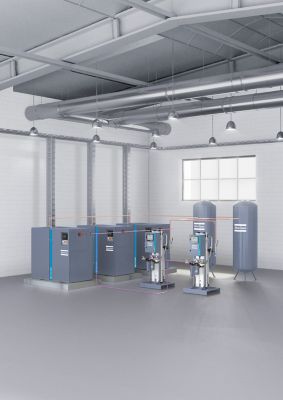
These centralised systems typically incorporate multiple rotary vane vacuum pumps operating together under intelligent electronic control.
If one pump requires servicing, additional pumps continue operating to maintain system performance and ensure patient safety.
Typical Medical Applications
- Operating theatres
- Emergency departments
- Intensive care units
- Respiratory care
- General hospital suction systems
Multiple-pump configurations provide built-in redundancy while intelligent controllers continuously monitor performance and automatically balance operating hours across each pump.
How to Choose the Right Vacuum Pump
No single vacuum pump is suitable for every application. Selecting the correct technology requires considering both your current production requirements and future expansion plans.
Questions to Consider
- What vacuum level is required?
- How much airflow is needed?
- Will the system operate continuously or intermittently?
- Is oil-free operation required?
- What are the maintenance requirements?
- How important is energy efficiency?
- Is the application food-grade or medical?
Matching the pump technology to the application helps maximise efficiency, reduce maintenance costs and improve long-term reliability.
Choosing the Right Vacuum Pipework
A vacuum system performs only as well as the pipework that distributes it. Poorly designed pipe systems can create pressure losses, reduce efficiency and increase energy consumption.
For industrial vacuum applications, smooth internal pipe surfaces and leak-free joints are critical for maintaining vacuum performance throughout the system.
Key Design Considerations
- Correct pipe sizing
- Minimal pressure losses
- Leak-tight joints
- Corrosion-resistant materials
- Future system expansion
- Ease of maintenance
Modern aluminium, stainless steel and engineered polymer piping systems offer lower pressure losses and significantly easier installation than traditional threaded steel pipework.
Why Choose Air Energy?
- Industrial Expertise Since 1993 — Supporting Australian manufacturers with compressed air and vacuum solutions for over 30 years.
- Independent Technical Advice — Recommendations based on your application, airflow requirements and operating environment.
- Complete System Solutions — Vacuum pumps, compressed air equipment, industrial pipework and supporting accessories from leading manufacturers.
- Trusted Global Brands — Supplying proven industrial equipment recognised for reliability, performance and energy efficiency.
- National Supply Capability — Fast delivery and technical support for projects across Australia.
Frequently Asked Questions
What is an industrial vacuum pump?
An industrial vacuum pump removes air or gas from a system to create negative pressure. This vacuum can then be used for manufacturing processes such as packaging, material handling, CNC machining, laboratory work, medical suction, and industrial automation.
What types of vacuum pumps are available?
The most common industrial vacuum pump technologies include rotary screw, rotary vane, claw, scroll, centrifugal and blower vacuum pumps. Each is designed for different flow rates, vacuum levels and operating environments.
How do I choose the right vacuum pump?
Choosing the correct vacuum pump depends on several factors including the required vacuum level, airflow demand, duty cycle, energy efficiency, maintenance requirements and whether oil-free operation is needed.
What industries use industrial vacuum pumps?
Vacuum pumps are widely used in manufacturing, food processing, medical facilities, laboratories, plastics, electronics, printing, packaging, mining, wastewater treatment and mechanical engineering.
Can vacuum pumps improve energy efficiency?
Yes. Modern rotary screw vacuum pumps automatically adjust their performance to match demand, reducing unnecessary energy consumption while extending equipment life and lowering operating costs.
What pipework is best for industrial vacuum systems?
Smooth-bore aluminium, stainless steel and engineered polymer piping systems help minimise pressure losses, reduce leaks and improve overall vacuum system efficiency compared with traditional threaded pipework.
Are oil-free vacuum pumps available?
Yes. Scroll, claw and some screw vacuum pumps provide oil-free operation, making them suitable for food processing, pharmaceuticals, laboratories and other applications requiring clean vacuum.
What maintenance does a vacuum pump require?
Routine maintenance depends on the pump type but commonly includes filter replacement, oil changes for lubricated models, seal inspection and monitoring operating performance to maximise service life.
Related Technical Guides
Need Help Choosing the Right Vacuum Pump?
Every vacuum application is different. Selecting the correct technology depends on your required vacuum level, airflow, operating conditions and future expansion plans.
Air Energy supplies a wide range of industrial vacuum pumps and supporting vacuum pipework from trusted global manufacturers, helping Australian industry build reliable, efficient vacuum systems.
Call 1300 99 55 26 or contact our team to discuss your application.